Step off the Milan–Meda expressway twenty kilometers north of Milan’s Porta Nuova skyline and the luxury boutiques give way abruptly to low-slung stone buildings, timber yards, and discreet anodized nameplates in Meda, Lissone, Cantù, and Mariano Comense. No glossy billboards announce who works inside. Yet nearly every iconic architectural sofa, sculpted walnut dining table, and travertine plinth unveiled at Salone del Mobile—or installed in Mayfair penthouses and alpine hotels—was engineered or fabricated within this fifteen-kilometer triangle of Monza e Brianza.
For interior architects, hospitality buyers, and emerging furniture labels visiting Lombardy for the first time, Brianza rarely works the way outsiders expect. Instead of vast vertically integrated mega-plants stretching over half a square kilometer, Brianza thrives as a tightly synchronized industrial ecosystem of hyper-specialized micro-workshops.
How the Distretto Industriale Actually Operates
In China’s Foshan or Vietnam’s Binh Duong, a large export plant often brings raw logs, foam cutting, powder coating, upholstery, and carton printing inside one fenced perimeter. Brianza solved manufacturing scale differently: through geographical hyper-density.
Within ten minutes of Lissone, a single curved lounge chair can pass seamlessly across five independent family-owned ateliers, each carrying decades of narrow mastery. A dedicated fusto workshop turns kiln-dried Slavonian beech or poplar into structurally dowelled, curved wooden internal frames. Five streets away, a CNC stone mill water-jets book-matched Calacatta Viola marble or Roman travertine slabs off digital templates. Across town, a metalworking shop TIG-welds brushed bronze or stainless steel bases and dispatches them for PVD titanium-brass plating before everything converges at the master upholsterer’s bench for multi-density polyurethane layering, down-wrap baffling, hand-stitching, and final inspection.
That distributed architecture explains both Brianza’s extraordinary craft flexibility and its pricing structure. Because master makers tap world-class specialist subcontractors down the street, a Meda workshop can build a bespoke 12-unit hotel lobby sofa suite to exact millimeter elevations without owning a steel foundry or a marble quarry.
Upholstery Craft: Frame Chemistry, Multi-Density Foams, and COM Math
What separates a contract-ready Italian sofa that holds crisp architectural seams after eight years of hotel lobby use from a residential lookalike that puddles after eighteen months sits almost invisibly underneath the textile.
- Kiln-Dried Structural Frames (8%–10% Moisture): Serious Brianza frame makers pair finger-jointed solid beech at primary stress joints with void-free birch plywood structural curves, avoiding brittle particleboard or green timber that twists inside heated European interiors.
- Elastomeric Webbing & Variable-Density Layering: Rather than wrapping a block of cheap single-density foam, skilled bench upholsterers build progressive comfort cores—high-resilience 40–45 kg/m³ base foam, softer 30–35 kg/m³ memory or transition layers, and channeled RDS-certified feather-down or Dacron batting envelopes that recover shape without flattening.
- COM & COL Precision (Customer’s Own Material / Leather): Specifiers supplying Belgian linen, wool bouclé, or French velvet directly to an Italian maker routinely miscalculate consumption. Plain 140 cm wide fabrics require standard linear yardage, while directional patterned weaves, large-repeat jacquards, and narrow-nap mohair or silk velvets demand 18% to 28% extra allowance for pattern matching and single-direction pile cutting—avoiding subtle two-tone shading across adjoining seat cushions.
When supplying Customer’s Own Leather (COL), buyers should specify total square meters rather than linear meters and clarify whether hides are full-grain aniline or lightly pigmented semi-aniline. Natural European bull hides average 4.8 to 5.5 square meters per skin, yet usable yield after trimming neck creases and belly scar zones typically lands around 68% to 75%. Ordering exact theoretical surface area leaves cutting benches short on the final armrest.
Timber Veneers, Matte Lacquers, and Architectural Stone
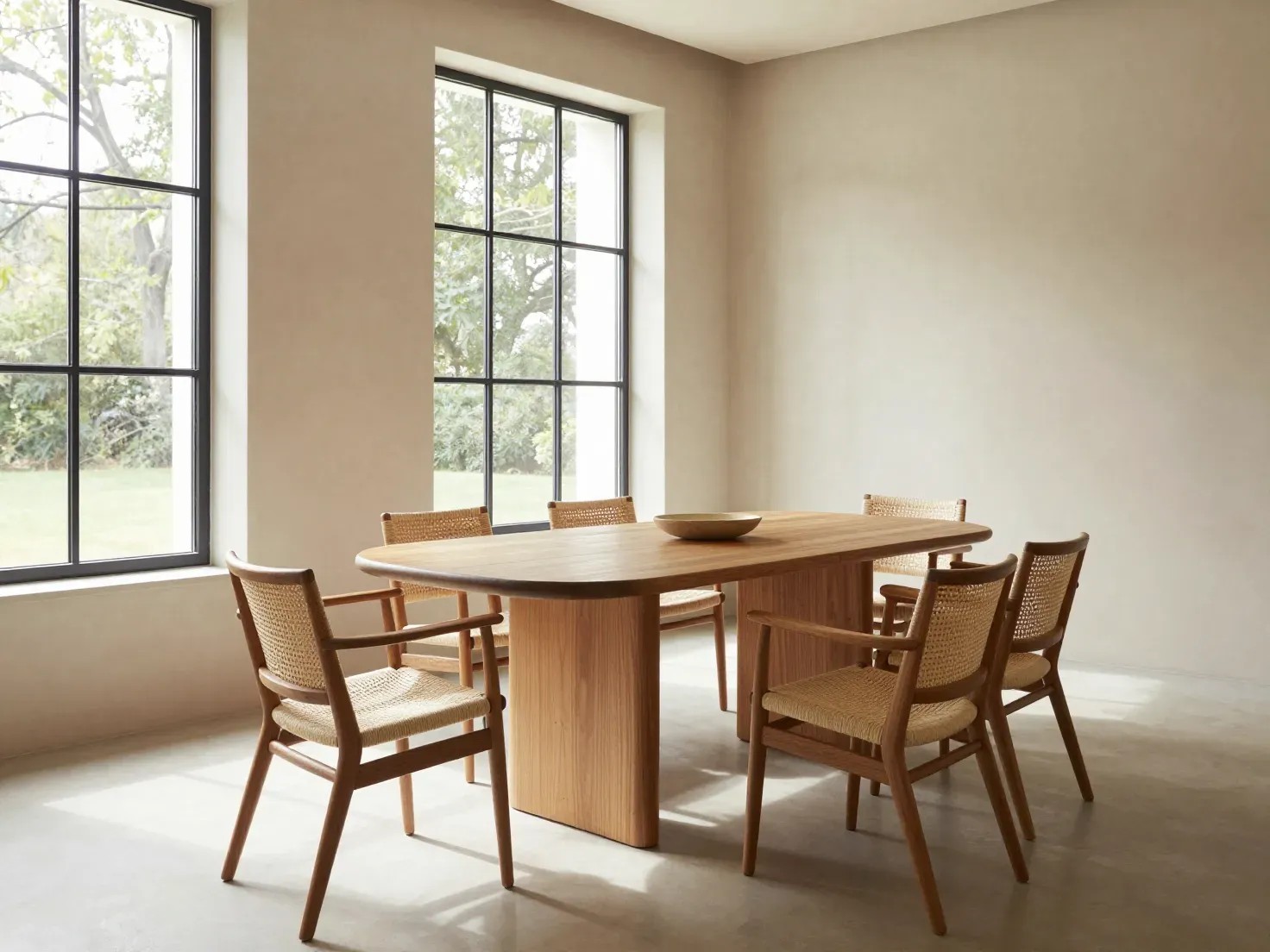
Casegoods and architectural dining tables in Cantù and Mariano Comense draw equally on regional finishing mastery. Even high-ticket Italian dining tables rarely use wide, single-piece unbacked hardwood planks; as humidity swings between damp Mediterranean springs and dry winter central heating, wide solid slabs cup and split unpredictably. Instead, Italian cabinetmakers laminate thick quarter-sawn Canaletto walnut, smoked European oak, or eucalyptus veneers onto stable multiply birch or engineered blockboard cores, matched symmetrically using book-matched or slip-matched grain sequencing and edged with solid timber lippings so corners take dining-chair impacts cleanly.
Surface chemistry matters just as deeply. Traditional high-gloss polyester piano lacquering—applied across six to ten sprayed coats and wet-sanded between cures—takes three weeks of controlled dust-free booth time alone. Conversely, modern zero-gloss open-pore acrylic sealers preserve natural wood grain depth while defending tabletops against red wine, espresso, and citrus rings.
Stain continuity across mixed production lots requires equally disciplined sample control. Natural Canaletto walnut and European white oak vary subtly from log to log depending on soil minerals and kiln cycle duration. Experienced buyers insist that the workshop retain two signed master finish paddles—one stored at the finishing booth and one held by the studio—before batching a dining room or architectural credenza series, checking tone under both warm 2700K hospitality lamps and cool northern daylight. Even a subtle shift in matte sheen value from 5 gloss units to 15 gloss units transforms how walnut reads across a sunlit dining terrace.
For stone dining tops in Carrara, Calacatta, Verde Alpi, or Pietra Grey, insist on photographic slab approval before CNC cutting begins. Natural marble quarries yield dramatic veining shifts from block to block inside the same lot. Reputable Brianza and Pietrasanta stone suppliers resin-reinforce hairline geological fissures on the underside with fiberglass mesh, hone edges to exact waterfall or bullnose profiles, and apply breathable fluoropolymer penetrating sealers rather than glossy film-forming plastics that scratch cloudy within months.
Joining Brass, Steel, and Lacquered Wood
Mixed-material architectural furniture defines modern Brianza output just as strongly as marble and upholstery. Sideboards combining smoked walnut doors with slim bronze legs, or sculpted café tables uniting brushed steel pedestals with honed stone tops, rely on mechanical tolerances rarely seen in pure woodshops. Structural metal bases are laser-cut, TIG-welded so seams grind completely flush, and then finished using galvanic brass baths, hand-burnished wax patinas (bronzo spazzolato), or ultra-hard PVD coatings that resist scuffing from cleaning carts and shoe heels.
Crucially, reputable makers isolate dissimilar materials mechanically where wood meets stone or metal: floating slotted brass cleats allow solid hardwood table rails to expand slightly across dry winter heating without cracking glued miter corners or shearing stone anchor inserts.
MOQs, Lead Times, and Three Mistakes Buyers Make in Lombardy
Unlike Asian container-volume manufacturers demanding 100 units per SKU, Brianza artisans routinely quote low-to-zero minimums—from a single bespoke prototype or architectural residence suite up to 250 hotel room packages—precisely because bespoke craft is native to the district. Standard custom lead times run 6 to 9 weeks from final shop-drawing sign-off and COM textile arrival, extending to 10 to 14 weeks for complex marble-inlaid casegoods or high-gloss polyester finishes.
- Overlooking the Ferragosto Closure: Virtually every stone cutter, plating bath, frame maker, and upholstery workshop across Brianza shuts down for three full weeks in August—and slows dramatically around late December. An order confirmed July 10 rarely clears production and white-glove freight before mid-to-late September.
- Treating Shop Drawings as Decorative Sketches: Factories manufacture strictly off signed technical CAD elevations showing seam locations, leg setbacks, underside steel reinforcement plates, and freight elevator clearance. Approving rough mood boards without checking doorway diagonal measurements has forced more than one monolithic 320 cm marble dining slab to stay parked on a Milan sidewalk.
- Skipping Crate Engineering for Export Sea and Air Freight: Heavy marble tops and delicate lacquered credenzas require ISPM-15 heat-treated fumigated wooden crates with high-density foam suspension and tilt indicators—never cardboard wrapping alone—if crossing oceans or transshipping through groupage hubs.
What to Bring on a Direct Inquiry or Factory Visit
Technical directors in Meda and Cantù respond rapidly when an inquiry reads like a working brief rather than a generic catalog request. Include orthographic CAD dimensions or target reference profiles, wood/stone/metal finish expectations, target destination market (crucial if UK BS 5852 CRIB 5 or California TB 117 fire foams are required), approximate piece counts, and realistic site handover dates. Ask specifically which work happens inside the company’s own walls—such as pattern cutting, bench upholstery, and final quality control—versus which processes are delegated to trusted neighbor ateliers down the road. Request clear lead-time buffers around August and December holidays, lock signed master wood and stone finish paddles ahead of production, and the engineering depth of Northern Italy opens without friction.
Related Regional & Sector Archives
Amplify & Circulate
Share This Briefing
Forward this compliance & sourcing guide to your buying, design, or quality team.
Direct Registry & Concierge
Need makers verified for these exact requirements?
Sign up free to unlock 3 verified factory contacts directly in the Atlas, or send your specification and destination market for a bespoke concierge shortlist.