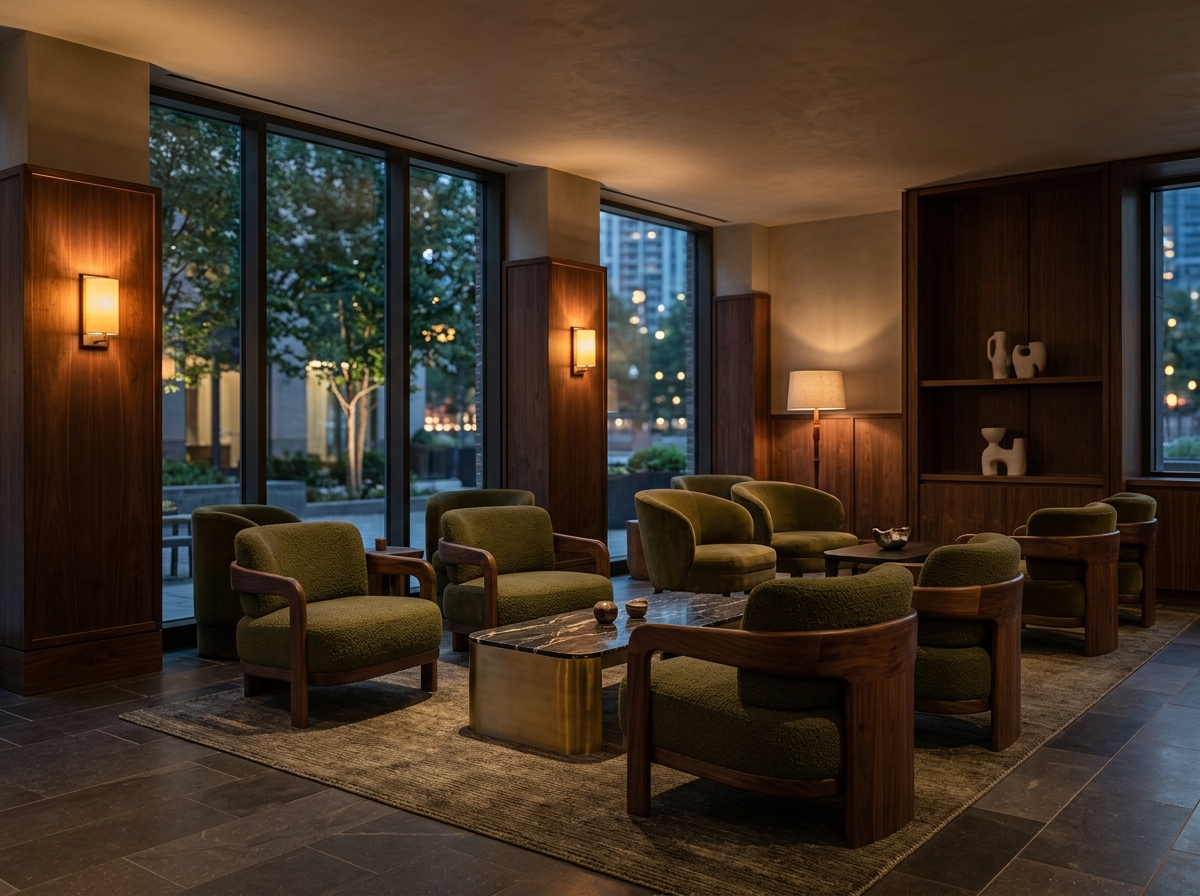
Outfit a 120-key boutique hotel across London, Zurich, or Lisbon through a traditional closed-book purchasing agent, and anywhere from 15% to 25% of your FF&E capital silently evaporates before a single bedside table reaches the loading dock. On a €2.4 million guestroom and public-area furniture package, that spread represents €360,000 to €600,000—enough capital to upgrade lighting across every suite, custom-weave lobby rugs, or cut months off project payback.
For years, hotel developers paid those intermediary spreads out of fear: fear that managing loose seating, bedroom casegoods, dining tables, and architectural millwork across multiple European or Asian plants would spiral into mismatched stains, missed container ships, and rejected fire inspections on opening week. Today, design-led hospitality studios and owners’ representatives increasingly manage direct factory procurement cleanly in-house—provided they enforce strict technical sequence.
Step One: Draw a Hard Line Between Millwork, Loose FF&E, and OS&E
Hospitality schedules stall fastest when scopes overlap ambiguously between the general contractor and furniture makers. Before requesting a single quotation, lock three separate responsibility buckets inside the Bill of Quantities (BOQ):
- Architectural Millwork & Fixed Joinery: Built-in reception desks, wall paneling, vanity cabinetry, and acoustic slatted timber walls scribed tightly to physical plasterboard tolerances. These generally perform best with regional joinery specialists who can site-measure raw walls after first-fix plastering.
- Loose FF&E (Furniture, Fixtures & Equipment): Guestroom beds, headboards (when freestanding), lounge chairs, dining tables, bar stools, banquettes, luggage benches, and decorative floor/table lamps. These standardized items travel cleanly by container or dedicated EU road freight from specialist clusters in Italy, Portugal, Poland, Türkiye, or Southeast Asia.
- OS&E (Operating Supplies & Equipment): Coat hangers, waste bins, minibar trays, tableware, and linen packages—kept completely outside structural furniture factory tenders so production lines stay focused on joinery and upholstery.
Building a Factory-Ready Bill of Quantities (BOQ)
Mood boards get ignored by production engineers or attract inflated risk padding in quotes. Every line item in an actionable hospitality BOQ carries an immutable specification code (for instance, GR-CH-01 for Guestroom Lounge Chair), exact overall millimeter dimensions, clear structural material hierarchy, COM textile yardage estimates, hardware finish codes (such as brushed antique brass or matte black PVD), exact quantity across king/twin/accessible room types plus 2%–3% attic stock spares for high-wear items, and required site arrival date.
Separating structural manufacturing cost from textile cost is equally vital. Whenever possible, negotiate upholstery fabric directly with the textile mill—obtaining hospitality-grade Trevira CS, Crypton, or Martindale-tested bouclé rolls at wholesale project meterage—and consign them directly to the furniture factory rather than burying fabric markups inside the frame quote.
Smart value engineering during direct factory quoting focuses strictly on hidden structure rather than guest-facing touchpoints. Swapping exposed solid-walnut desk carcasses inside recessed alcove niches for high-grade book-matched veneer over calibrated MDF, or standardizing drawer-box hardware across four room typologies while preserving solid timber edge profiles, bronze handles, and heavy stone vanities, frequently trims 14% to 18% off factory quotes without altering what guests touch or photograph.
The Non-Negotiable Gate: The Model Room Mock-Up
Never authorize bulk cutting of 120 headboards, 240 nightstands, or 300 dining chairs from flat PDF shop drawings alone. Across every serious hotel rollout above 35 keys, the mandatory Model Room (or First-Article Mock-Up) phase acts as the single cheapest insurance policy on the schedule.
At week four to six after shop-drawing approval, the awarded workshops fabricate one complete set of guestroom loose FF&E pieces in the exact target veneer lot, lacquer sheen, foam density, stitching gauge, and electrical outlet cut-outs. During a two-day physical review, the interior architect, hotel operations lead, and engineering consultant sit in the lounge chairs, inspect USB-C/power grommet clearances inside headboard backboxes, check drawer soft-close damping under load, and verify timber color harmony under actual 2700K hotel guestroom lighting rather than harsh factory fluorescent tubes.
Refinements caught in one mock-up room—like shifting a reading sconce cutout 25 mm outward or tightening seat-cushion crown stiffness—cost hundreds of euros to correct once. Discovering the same error across 140 installed rooms three weeks before hotel opening costs tens of thousands and triggers liquidated construction delays.
Contract Standards That Protect Hotel Operators From Liability
Residential furniture built for a private living room frequently collapses within twelve months inside a busy boutique restaurant or business hotel. Contract specifications must appear explicitly on every purchase order alongside third-party test documentation:
- Structural Strength & Fatigue: Require EN 16139 Level 1 (general contract seating) or Level 2 (severe contract usage—bars, nightclubs, 24-hour lobbies) or ANSI/BIFMA X5.4 testing for commercial lounge and dining chairs, alongside EN 1730 stability checks for dining and café tables.
- Fire Retardancy Without Market Confusion: UK projects and many international hotel chains require foam and upholstery composites certified to UK BS 5852 Ignition Source 5 (CRIB 5), whereas North American projects require California TB 117-2013 (and NFPA 260/ASTM E84 where specified). Confirm fire certification on both the interliner barrier and top cloth before ordering.
- Abrasion & Chemical Resilience: Specify commercial textiles rated at least 40,000 to 100,000 Martindale rubs (or 50,000+ Wyzenbeek double rubs in the US), plus polyurethane or catalyzed two-pack tabletop finishes tested against alcohol, boiling water, and ammonia cleaning agents.
Packaging Engineering and Container Volume Math
On international projects shipping across continents or mixing European production hubs with Southeast Asian outdoor and timber plants, freight cube discipline quickly overtakes unit price savings. A 40-foot High Cube shipping container yields roughly 66 to 68 usable cubic meters inside five-layer corrugated export cartons. Shipping fully welded dining chairs or broad-arm lounge chairs in giant individual boxes fills containers rapidly with empty air. Working with factory engineers early to tighten nesting profiles, design stackable bar-stool frames, or substitute bolted knockdown table legs trimmed neatly with protective corner guards routinely fits 25% to 35% more guestroom volume into each container without sacrificing assembled structural stiffness on the hotel floor.
Payment Milestones, Multi-Factory Consolidation, and Clean Handover
Direct procurement stays financially safe only when payment releases stay anchored to verifiable physical milestones. Standard healthy B2B hospitality terms follow a clean 30 / 40 / 30 or 40 / 50 / 10 cadence: 30% deposit against shop-drawing freeze and raw timber/stone procurement; 40% upon Model Room sign-off and inline frame inspection; and the remaining 30% strictly against passing an independent pre-shipment inspection verifying moisture levels (8%–11% wood equilibrium), stain consistency against signed physical control boards, protective carton drop packaging, and clean loading photos.
Insist on keeping physical finish control samples on both sides of the contract. Two small numbered walnut-veneer, brass-patina, and COM textile swatches signed and dated by the architect and the factory director eliminate subjective arguments months later when casegoods arrive on site under warm architectural lighting.
When sourcing across three or four specialist clusters—say guestroom casegoods from Paços de Ferreira in Portugal, upholstered lounge chairs from Poland or Brianza, and outdoor terrace pieces from Spain—nominate a single regional consolidation warehouse near port or trunk highway. All factories deliver boxed goods tagged clearly by Room Type and Floor Number (e.g., Floor 03 / Room 308 / Piece GR-CH-01) so final site trucks unload floor-by-floor in exact installation sequence rather than turning hotel corridors into chaotic puzzle warehouses.
Electrical and lighting coordination across borders deserves equal care before fabrication begins. Headboards integrating reading sconces, USB-C charging modules, and bedside dimmer switches must match local voltage, backbox cutout depth, and UL, CE, or UKCA wiring certification in the destination country. Request dimensioned electrical cutout drawings from the contractor’s MEP engineer before releasing casegoods for CNC milling, and require factories to test-fit one live lamp harness inside the Model Room headboard.
Finally, always reserve 2% to 3% attic stock spares on high-wear dining chairs, bar-stool leather cushions, bedside glass shelves, and signature woven textiles at initial production rather than attempting single-unit reorders eighteen months after opening. Dye lots shift and boutique fabrics retire cleanly; holding twenty matching spares in basement storage protects corridor uniformity through the first five years of hotel operations.
Manage BOQ precision, enforce the mock-up gate, match contract durability standards to the right specialist cluster, and direct factory procurement stops feeling risky—turning six-figure agent commissions back into lasting architectural quality inside the building itself.
Related Hospitality & Regional Archives
Amplify & Circulate
Share This Briefing
Forward this compliance & sourcing guide to your buying, design, or quality team.
Direct Registry & Concierge
Need makers verified for these exact requirements?
Sign up free to unlock 3 verified factory contacts directly in the Atlas, or send your specification and destination market for a bespoke concierge shortlist.